
The complete guide
Fence spikes for squirrels: how they help protect your fence line
Your fence is a squirrel highway. While you see a boundary between your property and the neighbour's, squirrels see a raised path, up away from ground predators, that links the yards, sheds, garages and rooflines along your street. A single fence line can carry squirrels from several yards straight to your bird feeders, your roof, your soffit vents and, in time, your attic. Much of the damage that follows, such as chewed fascia boards, gnawed cables, torn insulation, raided feeders and dug-up garden beds, can start with an open fence top that squirrels cross without a second thought.
Fence spikes for squirrels help close that route. A continuous row of spike strips along the top of your fence makes it awkward and uncomfortable for squirrels to walk across, balance on or grip. The result is a boundary that does two jobs: it keeps your yard private, and it makes the raised route squirrels use to reach the weak points on your property much harder to use. This guide covers fence tops: the products, how to install them and the practical steps that make fence spikes a strong first line of defence in squirrel control at home.
Why Fences Are the Priority in Squirrel Control
Of all the surfaces on a home property, fences are often a good place to start with squirrel deterrents. Understanding why fences matter so much helps explain why protecting them can go a long way for a fairly modest outlay.
Fences Connect Everything
A residential fence line is not an isolated structure. It connects to neighbouring fences, garden walls, sheds, garages, pergolas and, in many layouts, the house itself. This means a squirrel that steps onto your fence at any point along the boundary has a path to every structure the fence touches or passes near. A single unprotected fence can give a squirrel access to several buildings, gardens and roof access points without ever touching the ground. Protecting the fence line with spike strips breaks up this network in one job, which is why the fence is a sensible first priority when you are dealing with squirrels around your home.
Fences Are a Favourite Squirrel Route
Squirrels prefer raised travel routes because height gives them speed, safety from ground-level predators and a clear view of the area around them. In many neighbourhoods, fences are the easiest raised route to find. Trees give height but mean climbing up and down at each end. Walls give height too but are less common than fences in most yards. Fences offer a continuous raised path that often runs the full length and width of a property, which makes them a go-to route for squirrels in the area.
Fence Protection Creates a Perimeter Defence
Installing fence spikes for squirrels around your whole boundary creates a perimeter defence that helps stop squirrels before they reach the structures on your property. Rather than protecting buildings, feeders and garden beds one at a time, perimeter fence protection deals with the problem closer to its source, by making it harder for squirrels to use the raised routes that lead to everything inside. This approach is often simpler and better value than protecting each target separately, because one continuous installation covers the routes to many of them at once.
Types of Fence Spikes for Squirrels
Several kinds of fence top deterrent are sold for fences, each using different materials and shapes to suit different fence types, looks and needs. Squirrel Spikes Company sells two of them: the stainless steel strip on this page and the brown moulded plastic Squirrel Spikes strip.
Stainless Steel Fence Spike Strips
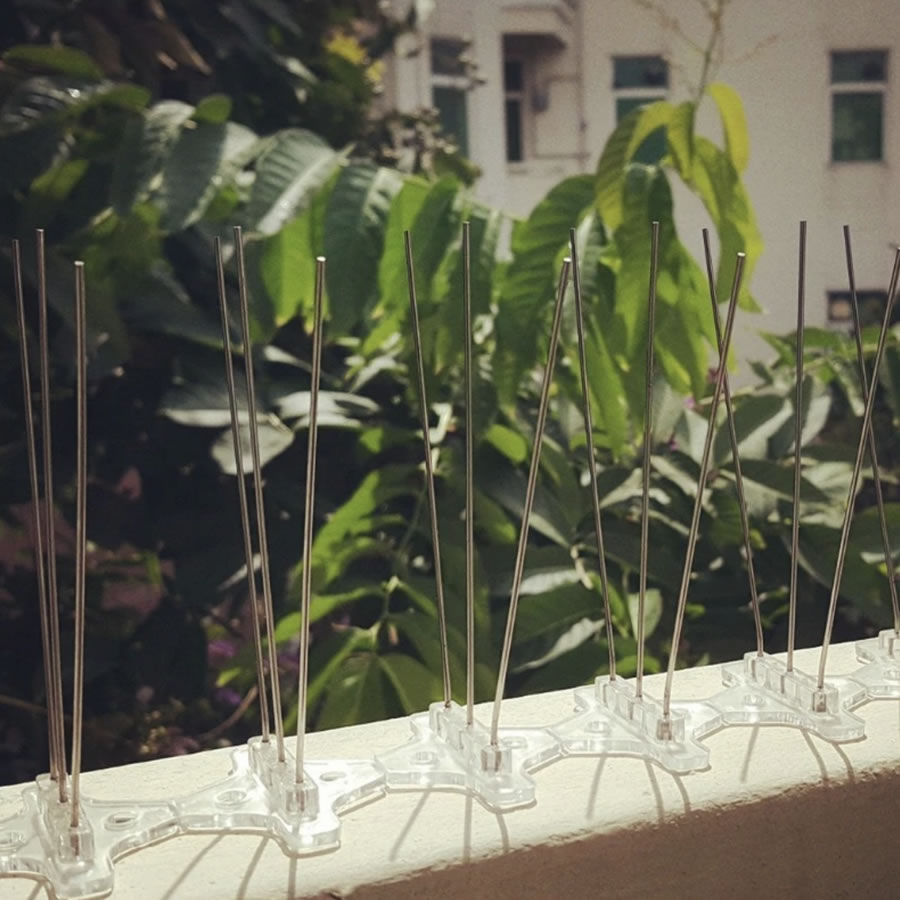
Stainless steel spike strips use rigid metal pins fixed along a base strip on top of the fence. The strip on this page has stainless steel wire pins, 1.3 mm thick and 115 mm long, pressed into a clear polycarbonate base 500 mm long, 23 mm wide and 5 mm high. With 60 spikes per metre and a protection width of 70 mm tip to tip, it makes a fence top awkward for a squirrel to walk or balance on. It fixes with silicone adhesive, nails, screws or cable ties, and suits long fence runs and spots where squirrels keep coming back.
Polycarbonate Fence Spike Strips
Some spike strips are made entirely of clear polycarbonate, with plastic pins that are hard to see from the ground, and people often choose them for front fences and decorative fencing. The store does not sell all-plastic clear strips. Its fence strip pairs a clear polycarbonate base, only 5 mm high, with thin stainless steel pins, which keeps the base low-key on the fence top. Whatever you choose, check your strips each season and replace any that have cracked, gone brittle or come loose.
Plastic Toothed Fence Toppers
Plastic toothed fence toppers are moulded strips with rows of short, triangular teeth that make the fence top uncomfortable to walk on. They look less aggressive than pointed spikes, and some people prefer them for front fences. Because the teeth are short, a squirrel may find enough flat space between them to pick its way across, so toppers work more as a mild discouragement than a firm barrier. The store does not sell toothed toppers; its moulded plastic option is the brown Squirrel Spikes strip, which has cone spikes rather than low teeth.
Rotating Fence Top Bars
Rotating bars are rollers mounted on brackets along the fence top. When a squirrel tries to grip the bar, it spins under the animal's weight, which makes it hard to get a footing and can tip the squirrel off. Rotating bars have a clean look that suits modern fence designs. They work best on straight runs where the bar can spin freely along its full length, and are less practical at corners, posts and junctions where the roller has to stop. The store does not sell rotating bars. For fences with frequent posts and changes of direction, spike strips like the stainless strip on this page give more even coverage.
Matching Spikes to Your Fence Type
Different fences give you different mounting surfaces, and the right fence spikes for squirrels are the ones that attach securely to your fence without weakening the fence or getting in the way of how the spikes work.
Wood Panel and Arched-Top Fences
Wood panel fences with a flat top rail give you a good mounting surface for fence spike strips. The flat rail offers a stable base for strips fixed with adhesive or screws, and wood bonds well with outdoor adhesives. For panels with an arched or scalloped top, the stainless strip on this page mounts on curved and irregular surfaces, so lay the strips along the top edge and butt them end to end so no gaps are left at the high and low points of the arch.
Privacy and Picket Fences
Privacy fences with a horizontal top rail offer the same flat mounting surface as panel fences and take spike strips the same way. Fences without a top rail, where the vertical boards or pickets end at the top with no capping piece, give a narrower and sometimes uneven surface. On these fences, fix the spike strips to a continuous length of pressure-treated wood screwed across the tops of the boards to make a flat, stable base for the strips. This board also ties the tops of the boards together and gives a neater finish beneath the spikes.
Metal Railings and Ornamental Metal Fences
Metal railing fences with a flat top rail take spike strips fixed with outdoor adhesive, self-tapping screws or cable ties, depending on the rail shape and material. For round-top railings, cable ties wrapped around the strip base and pulled tight around the rail give a secure hold that follows the curve. Ornamental metal fences with pointed tops may look like they deter squirrels on their own, but squirrels can grip the flat faces of the uprights below the points. Adding spike strips to the flat top rail between the uprights closes this gap.
Brick and Stone Wall-Top Fences
Many homes pair a low brick or stone wall with a wood or metal fence on top. The wall cap gives squirrels a second flat surface below the fence line that they can use as a path of its own. Protecting both the wall cap and the fence top leaves no unprotected ledge at either height along the boundary. Fix spike strips to the wall cap with an outdoor silicone adhesive or masonry screws, and fit separate strips on the fence top above using the method that suits the fence material.
Fence Posts and Post Tops
Many fences have posts that sit above or between the panels, whether they are wood, vinyl, metal or concrete. The narrow post top is a different surface from the panel's top rail, and squirrels will use unprotected post tops as stepping stones to get around spiked panels. Cover every post top with spike strip as well. For narrow post tops, the brown Squirrel Spikes strip is made of 12.5 cm snap segments that can be separated to fit. These small details at each post are easy to miss during installation but matter for keeping the barrier continuous.
Installing Fence Spikes for Squirrels: Step by Step
A careful, step-by-step installation gives you full coverage, a secure fix and a finished result that starts working from the first day. A little checking over the seasons helps keep it that way.
Measure and Plan Before You Purchase
Walk the full length of every fence line you plan to protect and measure the total linear metres accurately. Note any corners, posts, gates, and junctions where the spike strips will need to be cut, angled, or supplemented with additional pieces. Count the number of posts and gate tops that need individual coverage. Record the width of the fence top rail to confirm that your chosen spike strip width covers the full surface. This detailed measurement prevents both under-ordering, which leaves gaps in protection, and over-ordering, which wastes material.
Prepare the Mounting Surface
Clean the fence top rail along the full installation length. Remove moss, lichen, loose paint, cobwebs, and accumulated grime that would prevent adhesive from bonding or create an unstable base for the spike strips. On wood fences, allow the surface to dry thoroughly after cleaning, as moisture trapped beneath an adhesive-mounted strip will weaken the bond and eventually cause the strip to detach. On metal fences, remove any surface rust with a wire brush and wipe with a solvent to ensure a clean, oil-free bonding surface.
Install Strips With Zero Gaps
Begin at one end of the fence run and work steadily toward the other end, pressing each strip firmly into the adhesive or fixing it as you go. Butt each strip tightly against the last one with no gap between them. At posts, run the strip right up to the post face and cover the post top before starting the next panel. At corners, bring one strip right to the corner edge and start the next strip on the other face, making sure the corner point itself is covered by one strip or the other.
Protect Gates and Access Points
Gates are easy to miss in fence spike installations, and once the fence panels beside them are protected, a gate is an obvious place for a squirrel to try. Fix spike strips across the full width of each gate top rail, using adhesive rather than screws to avoid weakening the gate. Extend coverage to both gate post tops and to any flat hardware on the hinge and latch posts that a squirrel could use as a foothold to get past the spiked gate.
Allowing for Fence Maintenance and Replacement
Fences require periodic maintenance including painting, staining, and panel replacement. When installing fence spikes for squirrels, consider how the spikes will interact with future maintenance activities. Adhesive-mounted strips on wood fences may need to be removed and reinstalled when the fence is repainted. Screw-mounted strips can be unscrewed, the fence maintained, and the strips refixed. Planning for maintenance access at the installation stage prevents the frustration of discovering that your spike strips need to be destroyed to reach the surface beneath them.
Common Mistakes That Compromise Fence Spike Effectiveness
Even quality fence repellent spikes can fail to deter squirrels if specific installation mistakes create vulnerabilities that the animals discover and exploit.
Leaving Post Tops Unprotected
Every fence post top that is not covered is a stepping stone that lets a squirrel get around the spiked panels between the posts. On a typical backyard fence, a squirrel can easily leap from one unprotected post top to the next, using the posts as a row of safe landing pads that skip over the spiked sections entirely. Covering every post top is not an optional finishing touch. It is part of what makes the installation work as intended.
Using Spike Strips With Soft, Flexible Pins
Some spike strips have thin, flexible plastic pins that bend flat when a squirrel steps on them, and a squirrel can then walk across them as if they were not there. Before you buy, check what the pins are made of and how they sit in the base. The strip on this page has stainless steel wire pins 1.3 mm thick and 115 mm long pressed into a polycarbonate base, and the brown Squirrel Spikes strip has hard moulded plastic cone spikes. Pins that fold under a squirrel's weight are an easy mistake to avoid.
Leaving Gaps at Corners and Junctions
The points where your fence changes direction, meets a wall, or connects to a building are natural weak spots where coverage gaps tend to occur. These junctions are precisely where squirrels transition between structures, and an unprotected junction is all a squirrel needs to move from a spiked fence to an unspiked wall or building surface. Fill every junction gap with spike material, even if the section is only a few centimetres long, to maintain the continuous barrier that effective squirrel deterrence requires.
Allowing Debris to Accumulate
Fallen leaves, twigs and yard debris that settle on fence top spike strips can form a mat above the spike tips, letting a squirrel walk across the debris without touching the spikes. Fall is the peak season for this problem, and it lines up with the time squirrels are busy preparing for winter. Clear debris from your fence spikes regularly through the fall, and check again in early spring so the spikes are fully exposed before squirrels get busy again.
Other Steps That Help Protect Your Fence Line
Fence spikes for squirrels are a strong first step for protecting a fence line, and adding a few other measures helps cover the routes that spikes alone do not deal with.
Trim Overhanging Branches
A tree branch hanging over your fence gives squirrels a way over the top that drops them onto your property past the spiked fence line. Trim branches well back from your fence, walls and roof so squirrels have a harder time using them as a launch pad. Overhanging branches are a common way for squirrels to get past an otherwise complete fence spike installation, so this step matters if trees grow near your boundary, on your side or your neighbour's.
Address Vertical Climbing Routes Near the Fence
If your fence runs close to downspouts, utility poles or other vertical structures squirrels can climb, they may climb up and jump sideways onto the fence past the spiked section. Fitting climbing guards to nearby vertical surfaces makes this sideways route harder, so squirrels are left facing the spiked fence top itself, which is a much harder way over than a route around it.
Monitor and Extend Coverage Over Time
After installing pest spike strips for fences, observe your fence line over the following weeks for signs of continued squirrel activity. Look for fresh scratch marks, droppings, or sightings of squirrels on or near the fence that indicate they are testing the barrier or have found an unprotected section you missed during installation. Extend your spike coverage to address any new vulnerabilities you identify, and continue monitoring as the squirrel population adjusts its behaviour in response to the barrier. This adaptive approach ensures your fence protection evolves alongside the challenge it was installed to meet.
The Fence That Works Twice
A fence with squirrel spikes along its top does two jobs. It marks your boundary and it helps defend it. Every metre of spike strip you install closes off another stretch of the raised route squirrels use to reach your roof, your garden and your home. The cost is modest, the installation is straightforward, and the result is a boundary that makes squirrel traffic much harder without trapping or poisoning a single animal, with only an occasional check, and without the repeated reapplication that chemical and scent-based repellents need.
Start at the section of fence closest to where squirrels are causing the most damage, and work outward until every fence panel, post top, gate top and corner is covered. When the last strip is in place and the last gap is closed, your fence becomes much more of the barrier it always looked like, and the squirrels that have been running across it every day will have a far harder time using your property as their route.
How do fence spikes work to deter pests from my property?
The spikes stand up from a clear base along the fence top, so a squirrel has nowhere flat to put its feet and tends to look for another route.
Can pest spike strips be installed on all types of fences?
Most fence tops with a flat, solid surface can take them. Use UV-stabilised silicone adhesive, screws or cable ties to suit timber, metal or masonry.
Are fence repellent spikes safe for animals and pets?
They are a non-lethal deterrent that makes a surface uncomfortable rather than injuring an animal. Fit them where people and pets will not brush against the spike tips.
Do fence spikes require professional installation?
No. Most people fit them themselves with silicone adhesive, screws or cable ties.
Can pest spike strips be painted to match the colour of my fence?
We do not recommend painting them. The base is clear, so it takes on the colour of the fence underneath.
How long do fence repellent spikes last?
We do not publish a lifespan. How well a strip stays put depends mostly on the fixing, so clean the surface first and check the strips now and then.
Can fence spikes be used on walls and ledges?
Yes. The same strip suits wall tops, ledges and window sills, and a wide surface may need two rows side by side.
Do pest spike strips damage fences or surfaces?
Adhesive and cable ties leave the surface intact, while screws and nails leave small holes. Choose the fixing that suits the surface and whether you may want to remove the strips later.
Can fence repellent spikes be removed and reused if needed?
Strips fixed with screws or cable ties can usually be taken off and refitted. Strips glued in place are harder to remove cleanly.
Are fence spikes noticeable once installed?
The wire spikes can be seen up close, but the clear 5 mm base is hard to see from the ground.