
The complete guide
Anti squirrel spikes: a guide to ready-made and DIY squirrel spikes
You do not need to hire a pest control company to keep squirrels off your property. With the right strips, basic tools and a clear idea of where squirrels get onto your home, you can often fit anti squirrel spikes yourself over a weekend. It is a job many homeowners take on themselves, saving on installation fees and getting the satisfaction of solving a stubborn problem with their own hands.
Squirrel deterrent spikes are one of the easier pest control jobs to do yourself. They need no wiring, no special equipment and no chemicals to keep reapplying. Fitting them means fixing spike strips to flat or curved surfaces with adhesive, screws, nails or cable ties, which anyone comfortable with basic home maintenance can handle. Whether you buy ready-made strips or build your own, the aim is the same: a humane deterrent that stays in place and makes it much harder for squirrels to use your fences, walls and roofline as a path onto your home.
Ready-Made vs. DIY Squirrel Spikes: Which Approach Is Right for You?
Before you begin any squirrel spike project, the first decision is whether to purchase commercially manufactured anti squirrel spikes or build your own from scratch. Both approaches produce functional results, but they differ in cost, time investment, consistency, and long-term performance.
Advantages of Ready-Made Commercial Spikes
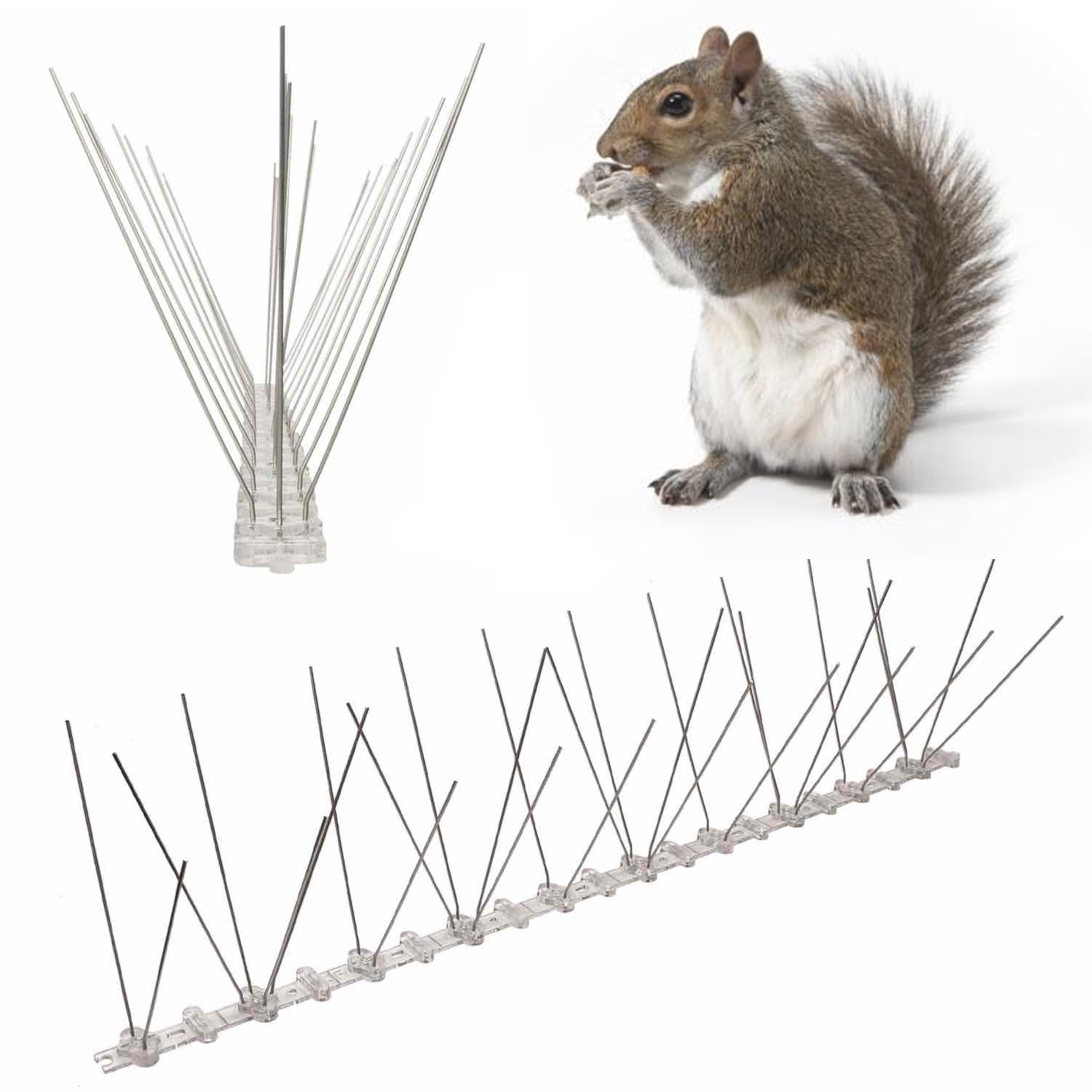
Ready-made squirrel deterrent spikes are made for the job, so you do not have to work out a design yourself. The stainless steel strip sold here has 1.3 mm wire spikes, 115 mm long, at 60 spikes per metre, spreading 70 mm from tip to tip on a clear polycarbonate base 500 mm long and 23 mm wide. The moulded plastic Squirrel Spikes strip is 50 cm long and 4.5 cm wide and does not rust. Both come in even lengths that butt end to end without gaps, and both fix with everyday methods such as adhesive, screws, nails or ties.
For most homeowners, ready-made spikes are the quickest route to a finished job. You buy the strips, fix them to the surfaces squirrels use, and you are done. There is no building, no hunting for materials and far less guesswork, because the spike length, spacing and base are already set. No spike stops every squirrel every time, but a ready-made strip gives you a consistent, humane deterrent without first having to trial a design of your own.
Advantages of DIY Squirrel Spikes Built From Scratch
Building your own DIY squirrel spikes appeals to homeowners who enjoy hands-on projects, want to customize the spike dimensions for a specific application, or prefer to use materials they already have on hand. A home-built spike strip can be tailored to the exact width of your fence, the precise profile of your wall cap, or the specific angle of your roof edge in ways that a standard commercial strip may not accommodate without modification.
DIY spikes also give you room to experiment. Common home builds use nails driven through a wooden batten, cable ties standing upright through a strip of rigid plastic, or galvanized wire bent into loops and fixed to a base board. If you try one, blunt every point and wear gloves and safety glasses, because the aim is to discourage squirrels, not injure them, and sharp points put you, your family, pets and wildlife at risk. A home build also needs checking in use, so watch how squirrels react to a short piece before you make more.
The Hybrid Approach: Commercial Strips With DIY Adaptation
Some homeowners use ready-made anti squirrel spikes for the long fence and wall runs, then make small custom pieces for awkward spots where a standard strip does not sit neatly. Post caps, odd corners, pipe brackets and curved surfaces can be fiddly. The stainless steel strip mounts on flat, curved or irregular surfaces, and the plastic strip separates into 12.5 cm snap segments, so try those first before building anything. Ready-made strips keep the spacing even along the main runs, and any home-made piece should have every point blunted.
What to Look For in Any Squirrel Spike System
Whether you buy squirrel deterrent spikes or build your own, a few things affect how well they work: spike height, firmness, spacing, surface coverage and tip safety. None of these has a single pass mark, so use the points below as a checklist, not a rulebook.
Spike Height
Spikes need enough height that stepping over them or stretching across to a clear patch behind is hard for a squirrel. The stainless steel strip sold here has 115 mm spikes that spread 70 mm from tip to tip, and the moulded plastic strip uses hard cone spikes on a 4.5 cm wide base. If you build your own, measure height from the top of the base to the tip, not from the mounting surface, and see how squirrels react to a short test piece before you make more.
Spike Thickness and Firmness
Spikes should stay firm when a squirrel pushes against them so the barrier keeps its shape. The stainless steel strip uses 1.3 mm stainless steel wire with each pin pressed into the polycarbonate base, and the plastic strip has hard moulded cone spikes. For home builds, firmness depends on the material: thin wire, plastic cable ties and wooden skewers bend or snap more easily than nails or heavier wire, so they tend to wear out sooner. Whatever you use, check now and then for pins that have bent or worked loose.
Spike Spacing
The gaps between spikes matter as much as the spikes. If there is a clear, flat path between them, a squirrel can pick its way through using the base as a walkway. The stainless steel strip carries 60 spikes per metre along its length, with the tips spreading 70 mm wide. Spacing is an easy detail to skimp on in home builds, where pins set wide apart to save materials leave easy footholds, so keep home-made pins close together and check them against how squirrels actually move.
Base Width and Surface Coverage
Your spikes should cover the full width of the surface you are protecting. A narrow strip centred on a wide fence rail leaves bare edges on both sides that a squirrel can walk along. Measure the width of the surface and compare it with the spike spread: the stainless steel strip covers 70 mm from tip to tip on a 23 mm base, and the plastic strip is 4.5 cm wide. For wider surfaces, fit two or more rows side by side, with the outer rows lined up with the outer edges of the surface.
Humane Tip Design
Squirrel deterrent spikes are meant to discourage, not injure. They work by making a surface awkward and unsteady to stand on, and the spikes sold here are non-lethal. If a home build uses nails or wire, file or grind every tip until it is blunt before fitting, and wear gloves and safety glasses while you work, because sharp points can hurt people, pets and wildlife. Rules on dealing with wildlife vary by province and municipality, so check local rules if you are unsure.
Building Your Own DIY Squirrel Spikes
If you choose to make your own squirrel spikes, these common home designs use easy-to-find materials and basic tools. Blunt every point and test a short piece first.
Nail-Through-Batten Method
This is one of the simpler home designs. Take a length of treated wooden batten wide enough to cover the surface you want to protect. Drive stainless steel or galvanized nails up through the batten from the underside so the ends stand up from the top, spacing them closely and evenly across its width and length. Before fitting, file or grind every nail end until it is blunt, wearing gloves and safety glasses, because sharp points are an injury risk to people, pets and wildlife. Then fix the batten to your fence top or wall cap with screws or adhesive.
The nail-through-batten method is cheap and lets you make the strip any length or width. Its drawbacks are weight, since a wooden batten is heavier than a plastic or polycarbonate base strip, and wear, since wood breaks down outdoors over time. Pressure-treated wood lasts longer than untreated wood, but the batten will still need checking and replacing in time. The stainless steel and plastic strips sold here have no wood to rot, though any strip is worth checking now and then for loose fixings.
Wire Loop Method
Cut short lengths of galvanized or stainless steel wire and bend each piece into a U or V shape. Drill a row of small holes along a strip of rigid material such as aluminum angle, PVC strip or treated wood, and push the wire loops through so both ends of each wire stand up as a pair of spikes. Fix the wires with a dab of epoxy or by crimping them under the strip. Cut wire ends are sharp, so file every end blunt and wear gloves and safety glasses. Pick a base material that suits the surface you are fixing to.
Cable Tie Fence Spike Method
For a quick, short-term fix, heavy-duty cable ties can be fixed along the top of a fence at close intervals, using screw-fixed saddle clips or threaded through holes drilled in a mounting strip. The standing tails act as semi-rigid spikes that make the surface awkward to walk along. This is the least durable home option, because cable ties break down in sunlight and turn brittle outdoors over time. Trimmed tails can leave sharp edges, so cut them square and smooth them off. Treat it as a stopgap while you plan a longer-lasting fix.
Important Considerations for All DIY Builds
Whatever method you choose, test a home build before you fit it across your whole property. Make a short test piece, fix it where squirrels are active, and watch it for several days to see whether they still get across. If they pick their way through or go around it, change the height, spacing or width and try again. A test piece takes little time to make and saves the frustration of finding a design does not work after you have fitted it along a whole fence line. While you watch, check for pins that have worked loose or are sharp.
Installing Anti Squirrel Spikes: A Step-by-Step Guide for Homeowners
Whether you are fitting ready-made strips or home-built spikes, the same steps help you get complete, secure coverage.
Step One: Survey and Measure
Walk your entire property boundary and identify every surface that squirrels are using or could use as a travel route. Measure the total linear length of fence tops, wall caps, roof edges, and other surfaces that need protection. Note the width of each surface, the location of corners, posts, gates, and junctions, and any specific challenges such as curved surfaces, irregular profiles, or hard-to-reach areas. Record everything on a simple sketch or list so you can calculate materials accurately and plan your installation sequence.
Step Two: Gather Materials and Tools
Based on your survey, buy or prepare the spike strips, fixings such as UV-stabilized silicone adhesive, screws, nails or cable ties, and any tools for trimming strips to length. For ready-made strips, divide your measured total by 50 cm to get the number of strips, then add a few extra for corners, post tops and cuts. For home builds, make all your spikes and base strips before you start, so you are not stopping to build halfway along a fence. Gather a sturdy ladder, work gloves, safety glasses, a tape measure, a pencil and a saw or heavy-duty snips.
Step Three: Prepare Surfaces
Clean every mounting surface along the full installation route. Remove moss, lichen, dirt, loose paint, and cobwebs that would prevent adhesive from bonding or create an unstable base for the strips. Allow timber surfaces to dry completely before applying adhesive. On metal surfaces, wipe with a degreasing solvent to ensure a clean bonding surface. On masonry, brush away loose material and dust. Clean surfaces bond better, hold longer, and produce a more professional finished appearance.
Step Four: Install From One End to the Other
Begin at one end of each fence or wall run and work methodically toward the other end. Apply adhesive or fixings, press the strip into position, and move to the next section. Butt each strip tightly against the previous one with no gap. At posts, cover the post top with a short spike section before continuing along the next panel. At corners, cut one strip to fit the angle precisely and start the next strip on the perpendicular surface. At gates, apply strips across the gate top and both gate posts to maintain continuous coverage across the entire boundary.
Step Five: Check for Gaps and Weak Points
After you finish, walk the whole route again and check every section for gaps between strips, bare post tops, unprotected gate sections and any spots where a strip has not stuck down properly. Pay close attention to corners and junctions, where gaps are most likely. Fill any gaps straight away, because even a short bare section can give a squirrel a place to land and a way around the spikes.
Step Six: Observe and Adjust
Over the first few weeks after fitting, watch the protected surfaces for signs of squirrel activity, such as scratch marks, droppings or squirrels testing the barrier. Fewer of these signs along the protected route suggests the spikes are doing their job. If squirrels are still crossing a section, look for a gap in coverage, a strip that has come loose, a surface wider than the spike spread, or another route around the spikes, such as an overhanging branch or a nearby roof.
Combining Squirrel Deterrent Spikes With Other DIY Measures
Anti squirrel spikes work better alongside other steps that deal with the different ways squirrels get onto your property and what draws them there.
Branch Trimming
Trim tree branches back so they do not hang over or sit close to your fence, wall or roofline. Overhanging branches let squirrels jump or drop onto your property past the spiked edges. Give as much clearance as you safely can, and use a qualified arborist for large limbs or anything near power lines. Trimming costs little and closes a common way around fence-level spikes.
Downspout and Climbing Guards
Squirrels kept off a spiked fence may try to reach your roof by climbing downspouts, pipes and other vertical structures next to the building. Cone-shaped guards or smooth metal bands fitted around these make climbing much harder and help close the upward route, while the fence spikes cover the route along the top. Home-made climbing guards can be cut from sheet metal or smooth plastic, shaped into a cone and clamped around the pipe. File cut metal edges smooth and wear gloves while you work.
Entry Point Sealing
Check your roof, soffits, fascia and wall vents for gaps, holes and worn sections that a squirrel could chew wider to get inside. Close these openings with heavy-gauge galvanized mesh, sheet metal or vent covers made for the job, which are much harder for a squirrel to chew through than expanding foam, light plastic or thin wood. Before you seal anything, make sure no squirrels, including young, are inside, so no animal is shut in. Sealed entry points give you a second line of defence if a squirrel gets past the spikes.
Repellent Application
Scent or taste-based squirrel repellents can be applied to specific items squirrels are chewing, such as wooden deck posts, outdoor furniture and cable runs. Capsaicin-based sprays are a common choice for discouraging gnawing on surfaces that are hard to protect with a physical barrier. Always follow the label directions. Repellents need reapplying from time to time, but they add a useful extra layer for targeted problem spots.
Squirrel-Resistant Bird Feeders
If bird feeders are drawing squirrels to your yard, swap standard feeders for squirrel-resistant models with weight-activated port closures or outer cages that let small birds reach the seed while making it much harder for squirrels. Taking away the easy food gives squirrels less reason to keep testing your spikes, and it helps your whole plan by dealing with what draws them in as well as how they get in.
Maintaining Your Spike Installation Over Time
Whether your anti squirrel spikes are ready-made or home-built, a little seasonal upkeep helps keep them working well.
Clear Debris Twice a Year
Leaves, twigs, and windblown material accumulate on spike strips, particularly during autumn. This debris creates a mat above the spike tips that squirrels can walk across without contacting the pins. Brush debris from your spikes in late autumn after leaf fall and again in early spring before peak squirrel activity season. A stiff hand brush or a blast from a leaf blower clears most accumulation quickly.
Inspect and Repair Annually
During your annual property maintenance routine, inspect the full length of your spike installation for loose strips, broken pins, adhesive failures, and surface deterioration beneath the mounting points. Reattach or replace any compromised sections immediately. For DIY timber-based spikes, check the batten for rot, splitting, or warping that could affect the spike positions. Replace deteriorated DIY sections with fresh builds or upgrade them to commercial strips for improved longevity.
A Weekend Project Worth Doing Well
Fitting squirrel deterrent spikes is one of those home projects where the effort is modest, the skills are basic and the job is done quickly. A weekend of measuring, fixing and securing strips along your fence tops, wall caps and roof edges gives you a deterrent that works day and night without batteries or chemicals, needing only a light check now and then. Ready-made spikes are ready to fit out of the box, while home-built spikes give hands-on homeowners the satisfaction of making their own, as long as every point is blunted.
Whichever route you take, the key is being thorough. Cover every surface, close every gap, protect every post top and gate, and pair your spikes with branch trimming, climbing guards and sealed entry points for a layered defence that makes your property much harder for squirrels to use. Do it carefully, check it now and then, and your anti squirrel spikes will keep discouraging an animal that is unlikely to give up on its own.