
Squirrel Spikes | Fence Spikes For Squirrels | Anti Squirrel Spikes
DIY squirrel spike strips, a live-catch trap and an ultrasonic deterrent, delivered across Canada.
Buy squirrel spike strips direct and online, ready for you to fit yourself.
Squirrel Spikes Company is a division of Caruso Consulting Co Ltd. We sell DIY squirrel spike strips, a live-catch squirrel trap and an ultrasonic squirrel deterrent online across Canada.
Each listing shows the product's specifications. Prices are in Canadian dollars, and our support team replies to email within 1 business day.
Looking for a do-it-yourself way to help keep squirrels off your fence, roof or gutters? Our spike strips fix with nails, screws, adhesive, tape or ties, so you can fit them yourself.
Just measure the area you need to protect and order the lengths you need. Each strip is 50 cm long.
Choose brown moulded plastic Squirrel Spikes or stainless steel wire spikes on a clear polycarbonate base, from the team at Squirrel Spikes Company.
Email us with any questions, or simply order online.
Who is behind Squirrel Spikes Company

Squirrel Spikes Company is part of a family-owned group of online stores. Our CEO, Renoo Caruso, is a Christian preacher based in Phetchaburi, Thailand. Renoo leads a local church with a congregation of more than 200 people and shares daily Bible teaching in Thai through renoo.faith and a YouTube channel with over 1,600 videos.
That faith shapes how we trade. Clear prices, honest product details, and a real person answering your email. We would rather lose a sale than mislead a customer.
What we sell
Squirrel Spikes
Moulded plastic and stainless steel spike strips, sold by the 50 cm strip with no minimum.
Squirrel Trap
A folding galvanised steel live-catch cage for squirrels and similar-sized animals.
Repellents
A solar ultrasonic deterrent with motion detection and a strobe, for gardens, sheds, decks and yards.
Squirrel Spikes: A Guide to Spike Strips for Fences, Walls and Roof Edges
Squirrels are acrobats. They leap between branches, run along power lines, climb walls and balance on surfaces that would stop most other animals their size. That is fun to watch from a distance, but frustrating when the route runs across your fence, along your wall, over your roof and into your attic. Squirrel spikes help by putting a physical barrier on the surfaces squirrels use as highways, which makes the protected area awkward to grip, balance on or land on.
Not every spike strip suits every spot. How well a strip works comes down to choosing the right one for the surface, fitting it with care and understanding how squirrels deal with obstacles. This guide covers how anti squirrel spikes work, where to fit them, how to install them and how to look after them, so your fence spikes for squirrels keep doing their job.
How Squirrel Spikes Work
The idea behind squirrel spikes is simple. Squirrels need a flat surface they can grip to walk, run or sit on. Spikes take that surface away and replace it with a row of points that are uncomfortable to move across. On a spiked surface, a squirrel struggles to place its paws flat, spread its weight or keep its balance. The aim is that the squirrel gives up on that route and goes somewhere else.
Squirrel spikes are a deterrent, not a trap and not a weapon. They are meant to make a surface uncomfortable and awkward to cross, not to injure the animal, and they are non-lethal. To work, a strip needs to be sturdy and fitted with no gaps, so a squirrel has no easy way to step between the points or around the ends. That humane approach makes spikes a sensible first step in keeping squirrels off a route.
Why Squirrels Are a Different Challenge Than Birds
This point is easy to miss when you shop. Bird spikes are made to discourage pigeons, starlings and other birds from landing on ledges and rooflines. They suit birds because birds are light, land from above and avoid putting their feet down among obstacles.
Squirrels are a different challenge. A grey squirrel is heavier than the birds that land on most ledges, and it has strong legs, sharp claws and good balance. It arrives sideways along a fence or wall and looks for any gap, loose strip or bare edge. That is why the way a strip is chosen and fitted matters. This store sells two kinds of strip for squirrels. Squirrel Spikes are a brown hard moulded plastic strip of cone spikes, 4.5 cm wide. The stainless steel strips use 1.3 mm wire spikes, 115 mm long, on a clear polycarbonate base, with a 70 mm protection width from tip to tip. Whichever you choose, fit it with no gaps and cover the full width of the route.
Types of Squirrel Spikes
Several kinds of spike product are sold for squirrels, each suited to different surfaces and looks. Knowing the main types helps you choose what suits each area of your property. This store sells two of them: moulded plastic strips and stainless steel wire spikes on a polycarbonate base. Spike mats and rotating bars are described below as general information only.
Stainless Steel Wire Spikes on a Polycarbonate Base
This store's stainless steel strips (Anti Squirrel Spikes, Fence Spikes and Gutter Spikes) use 1.3 mm stainless steel wire spikes, 115 mm long, pressed into a clear polycarbonate base 500 mm long, 23 mm wide and 5 mm high. There are 60 spikes per metre, with a 70 mm protection width from tip to tip. The strips mount on flat, curved or irregular surfaces with UV-stabilized silicone adhesive, nails, screws or cable ties.
The wire spikes spread out from the 23 mm base to the 70 mm protection width, which makes the strip harder for a squirrel to step around from either side. That suits roof edges, gutters, eaves and fence tops, and routes where squirrels keep coming back. Check the strips now and then to make sure the pins are still pressed firmly into the base.
Moulded Plastic Squirrel Spikes
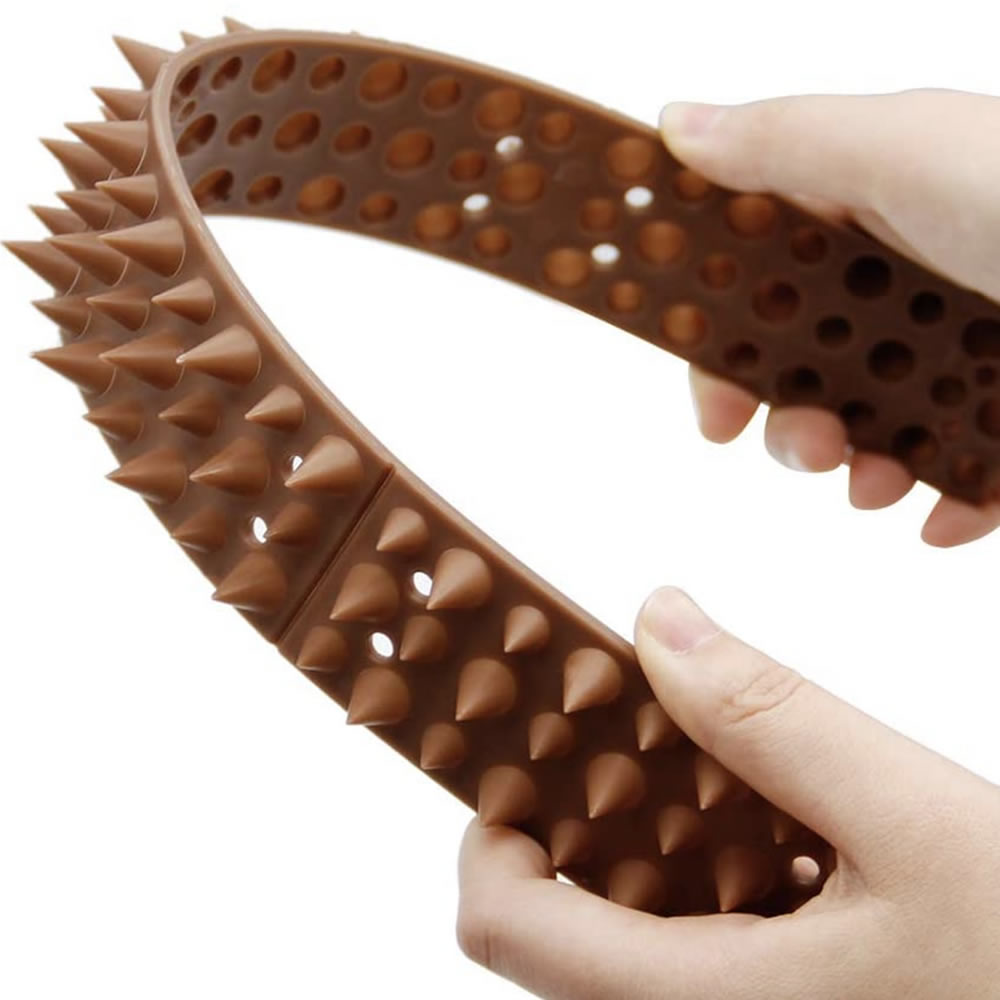
Squirrel Spikes are a brown hard moulded plastic strip of cone-shaped spikes, 50 cm long and 4.5 cm wide. The plastic does not rust, and each strip is made of 12.5 cm snap segments that you can separate to fit shorter runs, corners and narrow spots. The brown strips are easy to see, so they work as a visual as well as a physical deterrent. They fix with nails or screws, double-sided tape, glue or strong zip ties.
Sun and weather wear on any plastic left outdoors. No UV rating or lifespan in years is published for either of this store's strips, so treat them like any outdoor fixture. Check them each season, and replace any strip or segment that has turned brittle, cracked or come loose.
Plastic Spike Mats and Panels
Spike mats are flat panels covered in short spikes, made to cover wider surfaces than a single strip. People use them on flat areas such as shed roofs, wall tops and patio walls, where squirrels sit, rest or launch themselves onto higher structures. This store does not sell spike mats. To cover a wide surface with its strips, lay two or more rows side by side so no flat surface is left between them.
On narrow surfaces like fence tops, a mat is usually wider than the surface, so the extra hangs over the edges, looks untidy and catches leaves. A strip sized to the surface is the neater fit there.
Rotating or Spinning Deterrent Bars
Rotating bars are not spikes, but they deal with the same problem. A bar is mounted on brackets along the top of a fence or wall, and it turns when a squirrel tries to grip it, so the squirrel has trouble getting a foothold. Rotating bars suit straight fence runs and wall tops where the bar can spin freely, and some people prefer their smooth look to spikes. This store does not sell rotating bars.
Where to Install Fence Spikes for Squirrels
Squirrels follow regular routes between their nests, food sources and travel corridors. Finding these routes and fitting spikes along them helps steer squirrels away from your property. Several spots are common places to fit spikes.
Fence Tops
Fence tops are a common squirrel highway on residential properties. Squirrels use the flat top rail of timber and composite fences as a fast, raised path between trees, sheds, garages and the house. Fitting fence spikes for squirrels along the full length of the fence run makes that path hard to use and pushes squirrels to look for another route. Cover the whole fence line rather than just the sections nearest the house, because squirrels can get around a short protected section by dropping to the ground and jumping back onto the fence beyond the spikes.
Wall Caps and Wall Tops
Garden walls, boundary walls and retaining walls with flat caps give squirrels the same raised path as fence tops. Squirrels use wall tops to cross properties, reach rooflines, and get to upper-storey windows and soffits where they gnaw their way into attics. Anti squirrel spikes fitted along wall caps help block these routes and protect the roof access points squirrels use. Pay close attention to wall sections near trees or other structures, because these are likely spots where squirrels move from natural climbing routes onto your walls.
Roof Edges, Fascias, and Soffits
Where the roof meets the wall is a common entry point for squirrels getting into attics. Squirrels gnaw through fascia boards, soffit panels and roof underlayment to make openings into the warm, sheltered space under the roof. Fitting squirrel spikes along the roof edge, gutters and eaves makes it harder for a squirrel to sit in the spot it needs to gnaw its way in, which helps push it to give up and move on.
Downspouts and Vertical Access Points
Squirrels are skilled climbers and often use downspouts, pipes and other vertical structures as ladders to reach rooflines and upper walls. Spike strips are not suited to vertical surfaces. Cone-shaped or wrap-around guards sold for downspouts and poles make a climb harder by creating an overhang, and they can work alongside spike strips on fences, walls and roof edges. This store does not sell downspout guards.
Bird Feeders and Garden Structures
Squirrels are well known for raiding bird feeders, and the poles, posts and branches that hold feeders are common places for a baffle or guard. A baffle on the feeder pole makes the climb harder, and spike strips on the shed roofs, pergola beams and railings that squirrels use as launch points take away the platforms they jump from. Look at every route to the feeder, not just the pole, because squirrels will look for any unprotected path to the food.
How to Install Squirrel Spikes Correctly
Careful fitting helps your anti squirrel spikes do their job and stay firmly in place through weather and squirrel visits. Poor fitting leaves gaps squirrels can use, lets strips come away from the surface, and wastes strips that would have worked better if fitted properly.
Surface Preparation
Clean the mounting surface well before you fit the strips. Remove moss, lichen, loose paint, dust and debris that would stop adhesive from bonding or leave an unstable base for screws. On timber, make sure the wood is dry, because surface moisture weakens adhesive. On masonry, brush away loose mortar and crumbling surface material. A clean, stable surface gives the fixings the best chance of holding.
Choosing the Right Mounting Method
The fixing method depends on the surface and the strip. Squirrel Spikes fix with nails or screws, double-sided tape, glue or strong zip ties. The stainless steel strips fix with UV-stabilized silicone adhesive, nails, screws or cable ties. On smooth, clean surfaces such as painted timber, plastic and finished metal, run adhesive or tape along the full length of the base and press the strip firmly into place. On rough or porous surfaces such as bare brick, rough stone and unfinished timber, nails or screws usually hold better, because adhesive may not bond evenly to an uneven surface. On railings and thin edges, zip ties or cable ties give a firm mount that is easy to remove later.
On some surfaces, adhesive and mechanical fixings together give a firmer hold. Run adhesive along the full length of the strip and add screws or nails at intervals as a backup, so the strip stays in place if weather or a worn surface weakens the adhesive over time.
Closing Gaps in Coverage
Squirrels are clever problem solvers and will test any gap in your spike coverage for a way through. When fitting fence spikes for squirrels along a run, butt each strip tightly against the next with no gap between them. At corners and changes of direction, run one strip right to the corner edge and start the next from the side edge, so the corner itself is covered. With Squirrel Spikes, separate the 12.5 cm snap segments when you need a shorter piece. Where the protected surface meets a tree trunk, post or wall, take the spikes as close to the junction as you can, so a squirrel has as little room as possible to land and get around the strip.
Covering the Full Width of the Surface
A common mistake is fitting one narrow strip along the centre of a wide surface, which leaves bare edges on either side for a squirrel to walk along. Cover the full width of the surface. A single row suits a surface no wider than the strip: 4.5 cm for Squirrel Spikes, or the 70 mm protection width of the stainless steel strips. On wider surfaces like wall caps and flat roof edges, fit two or more rows side by side so no walkable surface is left on either side.
Protecting Curved and Irregular Surfaces
Not every surface is flat and straight. Curved wall tops, rounded fence post caps and uneven surfaces at roof junctions need a strip that can follow the shape. The stainless steel strips on a polycarbonate base mount on flat, curved or irregular surfaces. With Squirrel Spikes, separate the strip into 12.5 cm segments and fit them one after another around the curve, so the coverage stays continuous.
Maintaining Your Anti Squirrel Spikes
Squirrel spikes need little looking after. Once fitted, they sit in place without power, refills or resetting. A small amount of attention now and then keeps them working well.
Seasonal Inspection
Check your squirrel spikes twice a year: in early spring before squirrels get busy, and in late autumn before winter weather arrives. Look for strips that have shifted or come away from the surface. Look for damage from falling branches, bad weather or ladders used for other jobs. Check plastic parts, including the clear base of the stainless steel strips, for yellowing, cloudiness or brittleness, and make sure the wire pins are still pressed firmly into the base. Refix loose strips and replace damaged strips or segments. Clear any leaves, twigs or debris on or between the spikes, because a build-up can give a squirrel a way across.
Clearing Debris Accumulation
Leaves, twigs and windblown debris can build up on spike strips over time, especially in autumn and during storms. A thick layer of debris makes a mat that a squirrel can walk across without touching the spikes, which cancels out the deterrent. Clear debris during your seasonal check or whenever you notice a build-up. A stiff brush or a leaf blower clears most debris quickly without disturbing the strips.
Monitoring for New Squirrel Routes
Squirrels adapt, and they will find new routes when their usual paths are blocked. After fitting spikes on the main access points, watch your property for signs that squirrels have found a way around them. Scratch marks on new surfaces, droppings on new paths and fresh gnaw marks at other entry points all show that the squirrels have moved rather than left. Extend your spikes to these new routes as you find them. Each route you close leaves the squirrels fewer options, until your property is less attractive to them than others in the neighbourhood.
Common Mistakes That Reduce Spike Effectiveness
Even good-quality squirrel spikes can fall short if they are chosen or fitted poorly. Knowing the common mistakes helps you avoid them and get full value from your strips.
Buying Spikes Without Checking the Specification
Spike strips are sold for many different animals, and a strip made for one may not suit another. Before you buy, read the specification: the material, the spike length, the protection width and the fixing options. This store publishes those details for both of its strips, so you can match each one to the surface and the route you want to protect.
Leaving Gaps Between Strips
Even a small gap between two strips can give a squirrel somewhere to put a paw and a stepping stone across the barrier. Squirrels are patient and will find small gaps in your coverage. Butt strips tightly together, and cover corners and junctions with an extra strip or a separated segment so the line of spikes stays continuous.
Setting Realistic Expectations
Squirrel spikes help keep squirrels off the surfaces you protect. But they are one part of a wider squirrel plan, not an answer to every squirrel problem. Spikes help block specific routes and access points. They do not keep squirrels away from your property in general, and they do nothing for areas you have not covered. For a fuller plan, pair spikes with other steps: trim branches that overhang your roof, fit guards on downspouts that squirrels climb, and use squirrel-resistant bird feeders to take away the food. Seal any existing holes in your roof or soffits, but only once you are sure no squirrels are inside.
Used as part of this layered approach, anti squirrel spikes do what they are made to do: give you a humane, non-lethal barrier that makes your fences, walls and roofline hard for squirrels to use. Every strip you fit closes off another route. With enough routes closed, the squirrels that have treated your property as their playground are likely to take their acrobatics somewhere else.
What Is A Squirrel Control Spike?
Squirrel control spikes are strips of long, cone-shaped spikes. They discourage squirrels from walking, sitting or nesting on a surface. When they are used for birds, they are sometimes called anti-roosting spikes.
They can be fitted to many surfaces, such as ledges, signs, fences, gutters and roof edges. They help discourage squirrels and birds from landing, sitting or nesting there. Squirrel droppings are unsightly and unhygienic, and squirrels on a roof or in an attic can be noisy.
Squirrel control spikes for Canadian roofs
Squirrel control spikes are usually sold by length. This store sells them in 50 cm strips, so two strips cover one metre. They work by limiting the space squirrels and birds have to land, sit or build a nest.
Larger birds such as pigeons, crows and gulls will often choose to land somewhere else. A spiked ledge is uncomfortable and awkward to land on, which is meant to put them off without harming them.
These spikes can be fitted on ledges, walls, signs, security cameras and gutters to help keep squirrels from landing or nesting there. Use them as one part of a wider squirrel plan.
In towns and cities, squirrels and birds often live close to homes and buildings, which is where spikes tend to be used.
Rules on dealing with wildlife vary by province and municipality. Check local rules before you take action against squirrels or birds on your property. Spikes are a non-lethal option: they discourage animals from using a surface without harming them.
Plastic Deterrent Squirrel Control Spikes
Spikes are also used to discourage other animals, such as raccoons and opossums, from crossing or sitting on certain surfaces.
The aim is to help prevent damage and repair costs by making those surfaces harder for animals to use, without harming them.
Fit spikes out of reach of children and pets, and wear gloves when you handle the strips.
Some spike products are electrified to give an unpleasant shock. These can seriously harm birds and other animals, so check local rules before using any electrified deterrent. This store's spikes are not electrified.
Larger, heavier spike strips are also made for security, to discourage people from climbing fences.
Those are a different product. This store's strips are made to deter squirrels and are not a security barrier for people.
Frequently asked questions
Does Squirrel Spikes Company accept returns?
Yes. Change-of-mind returns are accepted within 15 days of purchase in original packaging with proof of purchase, with tracked return postage at your cost. If an item is damaged, faulty, wrong or not as described, we cover the return postage and put it right.
Can you help with a squirrel problem that keeps coming back?
Yes. Email theteam@squirrelspikes.shop and customer support will reply within 1 business day to talk it through. Animals can get used to sound, so the ultrasonic deterrent works best as part of a wider plan with spike strips or the trap.
Do you sell spikes for curved surfaces?
Yes. Anti Squirrel Spikes, Fence Spikes For Squirrels and Gutter Spikes mount on flat, curved or irregular surfaces. The plastic Squirrel Spikes strip separates into 12.5 cm segments to fit shorter runs.
Are your spikes suitable for narrow ledges?
Measure your ledge first. The stainless steel strips have a base 23 mm wide with spikes spreading 70 mm tip to tip, and the plastic Squirrel Spikes strip is 4.5 cm wide.
Who owns Squirrel Spikes Company?
Squirrel Spikes Company is a division of Caruso Consulting Co Ltd.
Can your products help keep squirrels from nesting in my roof?
They can help. Gutter Spikes along gutters, eaves and roof edges make it harder for squirrels to climb up, and the ultrasonic deterrent can be mounted on eaves. If a squirrel is already there, the live-catch trap is an option once you have checked your local rules on trapping and release.
Do you sell low-profile spikes?
Yes. The stainless steel strips sit on a clear polycarbonate base just 5 mm high, which keeps them low along the surface. The plastic Squirrel Spikes strip is brown.
Do you have a showroom?
No. Squirrel Spikes Company sells online only across Canada, so there is no showroom or shop to visit. Everything is delivered to your door.
What materials are your spikes made from?
Squirrel Spikes are hard moulded plastic that does not rust. Anti Squirrel Spikes, Fence Spikes For Squirrels and Gutter Spikes are 1.3 mm stainless steel wire on a clear polycarbonate base.
Can I install your products myself?
Yes. The spike strips fix with nails, screws, glue, adhesive, tape or ties depending on the strip, the Squirrel Trap arrives assembled, and the ultrasonic deterrent mounts on a fence, tree, shed, deck or eave.
How do I know how many spikes to buy?
Measure the run you want to cover in metres. Every strip is 50 cm long, so order two strips per metre and round up.
What animals are your products for?
Squirrel Spikes Company focuses on squirrels. The spike strips and ultrasonic deterrent discourage squirrels, and the live-catch trap also suits similar-sized animals such as chipmunks, rats, weasels and raccoons.
Can your spikes be glued or screwed down?
Both. The plastic Squirrel Spikes strip fixes with nails or screws, double-sided tape, glue or strong zip ties. The stainless steel strips fix with UV-stabilised silicone adhesive, nails, screws or cable ties.
Are your spikes harmful to squirrels?
Our spikes are a non-lethal, humane deterrent. They make a surface uncomfortable to climb onto or sit on rather than catching the animal.
Is it cheaper to buy in bulk?
Larger orders are quoted per enquiry through the Wholesale page. On any order, delivery is free once your goods total reaches $75, and the code valued-customer takes 15% off the items.
Can I get advice on which product to choose?
Yes. Email theteam@squirrelspikes.shop with a description of the spot you want to protect, and customer support will reply within 1 business day. There is also a chat assistant on the site.
Where is Squirrel Spikes Company based?
Our Canadian administration office is at 240 Richmond St W, Toronto, ON M5V 1V6. We sell online only, so the office is not a showroom.
Do you offer humane deterrents?
Yes. Every product we sell is non-lethal: spike strips and the solar ultrasonic deterrent discourage squirrels, and the Squirrel Trap is a live-catch cage.
How long do your spikes last?
We don't give a lifespan in years, because it depends on where and how the strips are fitted. The plastic strip does not rust, and the other strips use stainless steel wire on a polycarbonate base.
What surfaces can I protect with your products?
Spike strips suit fence tops, gutters, eaves and roof edges, and the stainless steel strips mount on flat, curved or irregular surfaces. The ultrasonic deterrent mounts on fences, trees, sheds, decks or eaves.
Do you ship across Canada?
Yes. We sell online across Canada, with free delivery on orders of $75 or more, otherwise a flat $22. You get a tracking number by email once your order ships.
Are your products made for outdoor use?
Yes. The spike strips are made for fence tops, gutters and roof edges, and the Ultrasonic Squirrel Deterrent is a solar powered outdoor unit with a sealed back cover. The plastic strip does not rust.
What is your delivery time?
Orders are dispatched within 2 working days and then delivered in up to 7 working days by tracked courier. An Express Shipping option is also available for a flat $22.
Can you supply bulk orders for commercial use?
Yes. Send your enquiry through the quote form on our Wholesale page or email theteam@squirrelspikes.shop, and pricing is quoted per enquiry.
Is fitting the spikes a DIY job?
Yes. Each 50 cm strip fixes down with everyday fixings, and the plastic strip snaps apart into 12.5 cm segments for shorter runs. We do not offer an installation service.
What types of spikes do you sell?
Two types. Squirrel Spikes is a brown moulded plastic cone-spike strip at $9 per 50 cm, and the stainless steel wire strip on a clear polycarbonate base is sold as Anti Squirrel Spikes ($10), Fence Spikes For Squirrels ($9) and Gutter Spikes ($9).
Is it safe to buy without seeing the product in person?
Each product lists its measurements and materials, so you can check the fit before you order. If an item arrives damaged, faulty, wrong or not as described, we cover the return postage and put it right, and change-of-mind returns are accepted within 15 days.
How do I choose the right squirrel spikes?
Start with where they are going. Fence Spikes For Squirrels are listed for fence tops, Gutter Spikes for gutters, eaves and roof edges, and Anti Squirrel Spikes for flat, curved or irregular surfaces, while the brown plastic Squirrel Spikes strip separates into 12.5 cm segments.
What does Squirrel Spikes Company focus on?
Squirrels. We sell spike strips, a live-catch trap and a solar ultrasonic deterrent, all non-lethal, online across Canada.
How do I shop with Squirrel Spikes Company?
Order online and check out as a guest, paying by card through Stripe or with PayPal. Prices are in Canadian dollars, and support is at theteam@squirrelspikes.shop.
Everything we promise is written down: